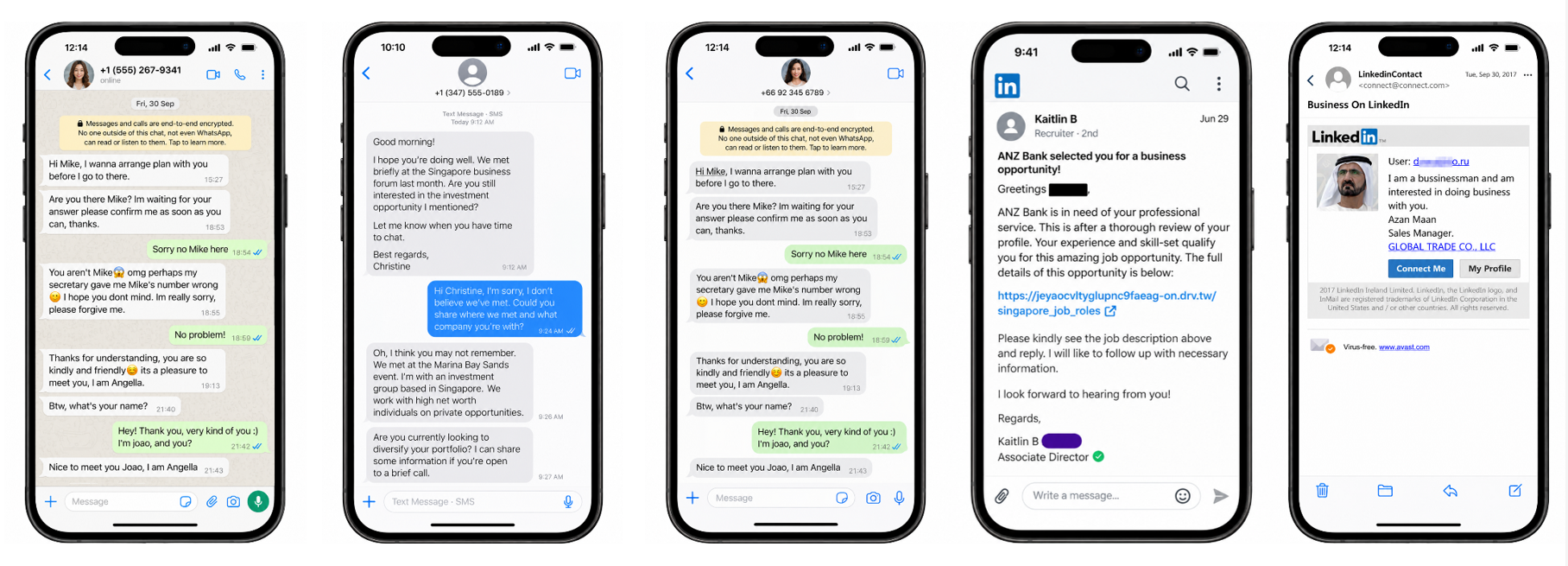
We’ve all received these: a text from an unknown number asking whether we’re still meeting for coffee, a stranger who seems to have mistaken us for someone else, or a LinkedIn message that feels just a little off.
For many of us, recognition is almost instantaneous. We get that gut feeling, identify the message as a scam, and hit Block.
Sometimes blocking is the right move. But the only way to know is to ask: “Are you there willingly?”
Why Ask the Question?
For those unfamiliar with the scams behind these messages, they often originate in Southeast Asia and, unfortunately, they work. The U.S. Treasury Department estimates that Americans lost at least $10 billion to Southeast Asia-based scams in 2024.
A significant portion of the online fraud originating in Southeast Asia is conducted from industrial-scale scam compounds. These criminal enterprises do not stop at cybercrime; they also have their hands in drugs, prostitution, and human trafficking, all of which support their scam operations.
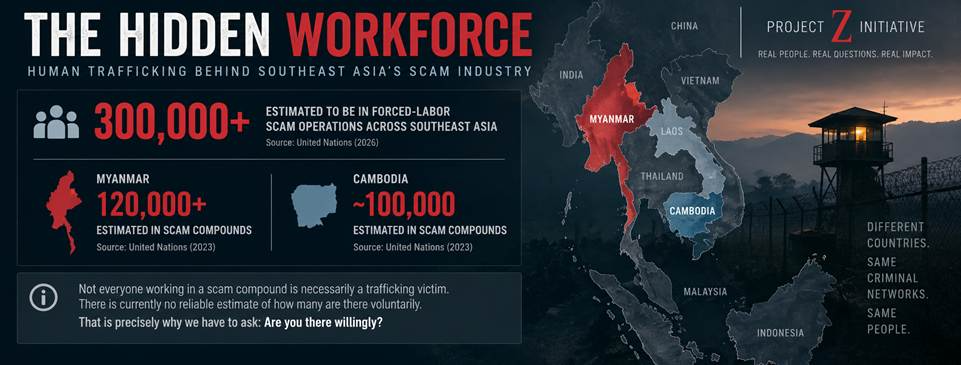
They traffic individuals into the compounds to work, keep supervisors happy with on-site KTVs - karaoke bars filled with prostitutes and illegal drugs - and there are even reports of workers being forced to use methamphetamine to make them work harder. UN estimates place more than 300,000 people in Southeast Asia in forced cybercrime, including online scam operations.
“Workers,” or scammers, are recruited internationally through social media, online advertisements, and recruiters promising legitimate jobs - often in customer service, technology, sales, or other ordinary occupations. The postings promise attractive wages and, for many people living in poverty, an opportunity to support their families back home.
They travel to Thailand believing they are beginning legitimate employment. Upon arrival, however, they discover that no job is waiting. Instead, they are trafficked at gunpoint across international borders into Myanmar, Cambodia, or elsewhere and delivered into compounds operated by organized criminal networks.
Once inside, passports and phones are confiscated, movement is restricted, and communications are monitored. Victims describe extraordinarily long hours conducting online fraud under threats of punishment. Some are beaten or tortured for failing to meet quotas. Some are sold from one compound to another - or into organ trafficking - if they lack the desired skills or fail to perform. Others are told that the only way out is for them or their families to pay substantial sums of money.
INTERPOL describes the phenomenon as “human trafficking-fueled fraud.” The person sending you that ridiculous wrong-number text may be trying to steal your money, but they may be doing it because someone is standing behind them making sure they do.
That distinction is why I ask the question.
“Are You There Willingly?”
In previous articles, and in my book The Man Called Z, I have asked readers to do something very simple before automatically blocking one of these messages: ask the question. It is something I do myself.
That does not mean every person I ask turns out to be a trafficking victim. They don’t. It does not even mean I believe someone simply because they answer no. Some people participate voluntarily, some will lie, and someone already engaged in fraud has given you an obvious reason to remain skeptical.
But if they really are trapped, your message may be the difference between another beating and going home. In my experience, I get roughly one meaningful response for every 15 or 20 scammers I ask. Even then, the response is not necessarily immediate.
Imagine yourself trapped in a foreign country, perhaps for years. You do not speak the language. You are exhausted from 16-hour shifts and surrounded by people with guns and tasers who monitor every computer. You watch coworkers pulled from their chairs for failing to scam hard enough. What do you do when a stranger asks whether you are there willingly? Can you safely reply? Could the question itself be a trap testing your loyalty?
For most, simply receiving the message is dangerous. That is why I generally provide an alternative way to reach me, such as Signal or email, and then leave it alone. Many never contact me. Occasionally, someone does.
One of those people contacted me recently. What followed is a useful case study - not because I know how his story will end, but because it demonstrates what can happen after someone answers, how low the opportunity cost of engaging really is, how credibility can be evaluated, and what an ordinary person can realistically do with the information.
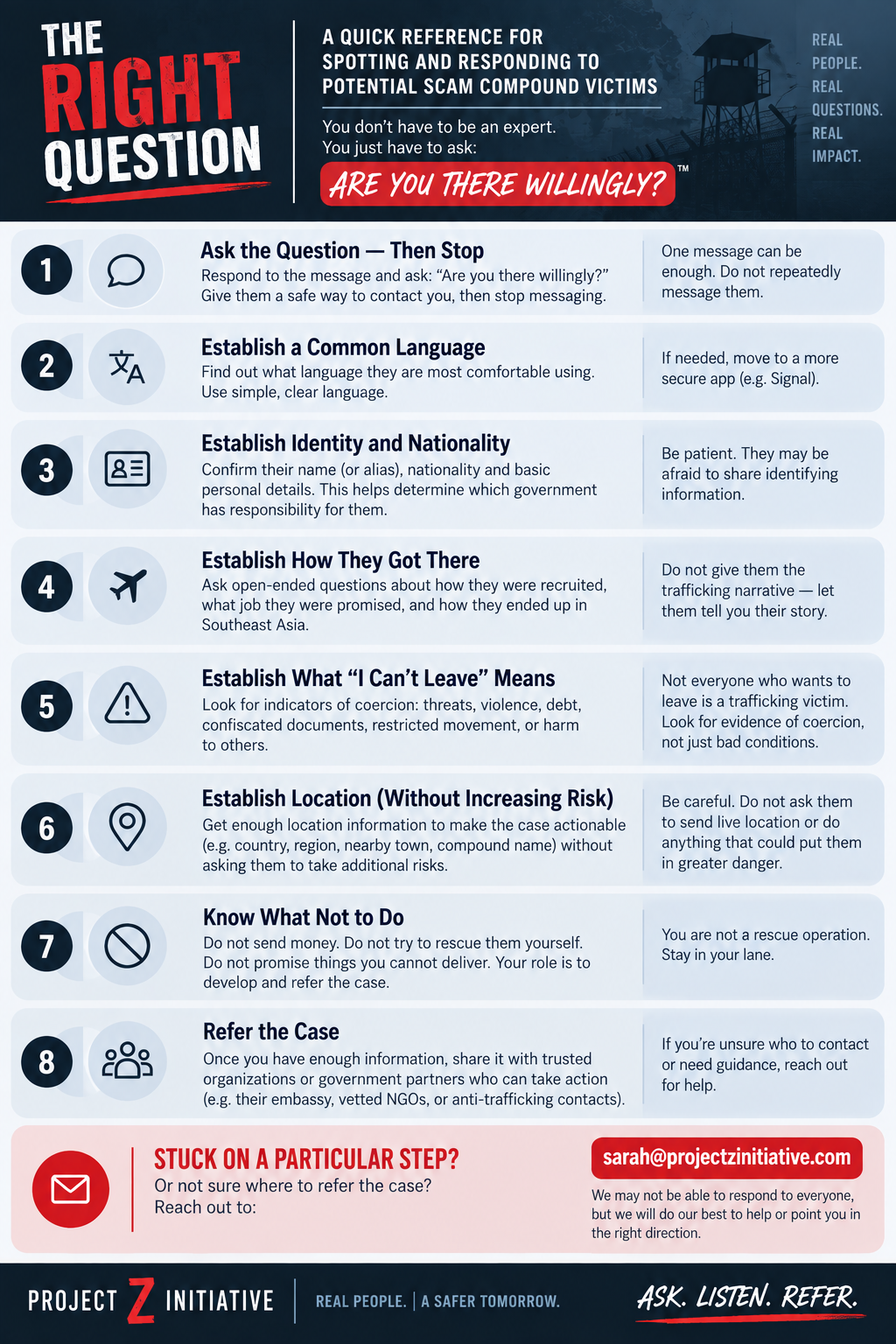
What follows is a step-by-step guide to initiating the repatriation of a trafficking victim in less than 45 minutes.
1 MINUTE
Ask the Question - Then Stop
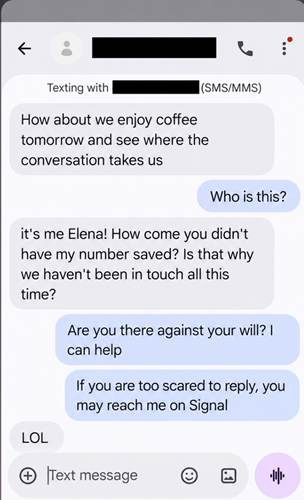
I gave him a way to reach me privately if he ever needed help, and then I stopped communicating with him.
That last part is important. Do not repeatedly message the person. If they are being held in a scam compound, you do not know who is standing behind them, who has access to their device, or when communications are monitored. A well-intentioned follow-up could put them in danger.
Give them a safer way to find you later. Signal provides end-to-end encryption and disappearing messages; email is another option. Then stop. You have opened a door. Let them decide whether and when it is safe to walk through it.
Don’t launch a full-scale rescue operation.
Your first job is not rescue. Your first job is information. You do not yet know whether the person, identity, location, or story is real. You are developing enough reliable information to make a responsible referral.
2 MINUTES
Establish Their First Language and Your Process
Before beginning your questions, determine the person’s first language. If it is not English, they may be using a translation tool, where important meaning can be lost. An AI tool can help reword an English sentence so that it translates directly into the person’s language without changing its meaning.
Firing a barrage of questions at a victim who may have endured captivity, beatings, and isolation will get you nowhere. Explain that you want to help but cannot promise that you can. Tell them you need to ask questions to determine the next step. I usually spread mine over a day or so and add occasional human questions: “What meal do you miss most?” or “Tell me about your parents.”
Explain early that you will need their full legal name and cannot make a referral without it. It is better to disclose that calmly at the outset than to make it feel like a threat later.
5 MINUTES
Establish Their Identity
The first category of questions should establish identity and nationality. You are trying to move the case from “a stranger on Signal says he is trapped in Myanmar” to a person who can be identified by a government, embassy, or NGO.
Nationality matters because governments respond very differently. Some have established diplomatic relationships, repatriation mechanisms, and NGO partnerships. Others have shown considerably less ability - or willingness - to intervene.
Getting someone out and getting them safely home are not always the same thing. Some governments treat returnees primarily as trafficking victims; others investigate them for participation in the fraud. Early in the conversation, you need answers to three questions:
- Will this person’s government intervene?
- Can it bring them home?
- What is likely to happen when they get there?
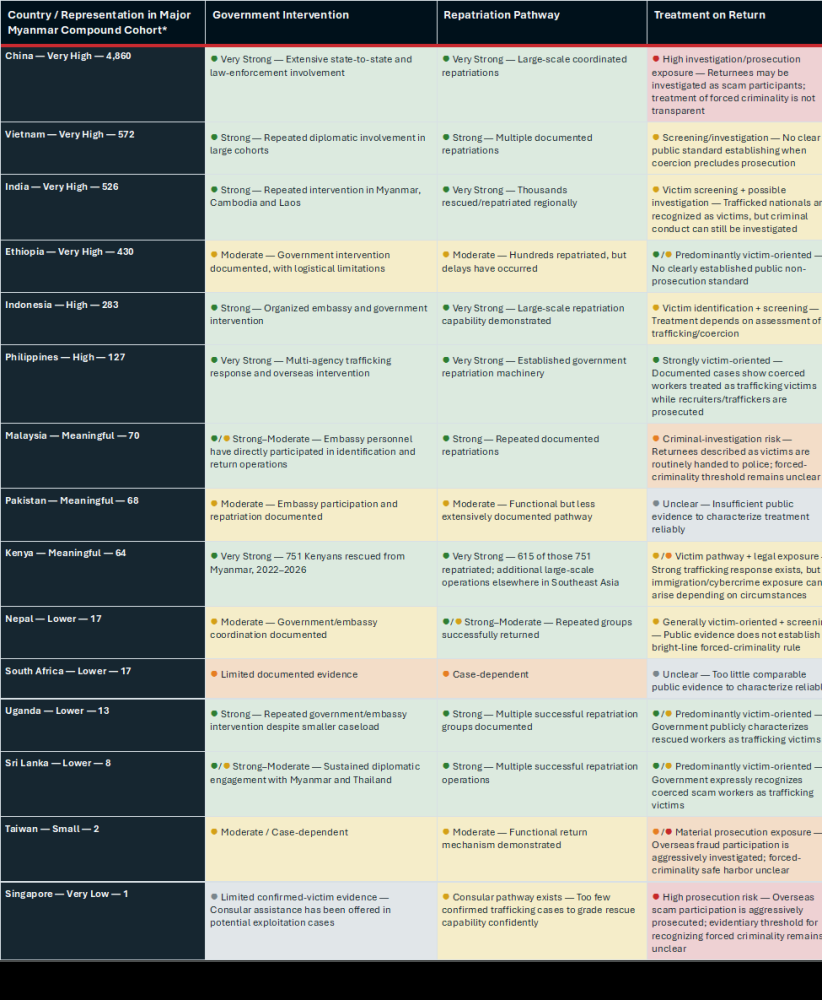
“Government intervention” does not generally mean armed teams entering compounds. It usually means diplomatic engagement and coordination with Myanmar or Thai authorities, local armed groups, NGOs, and other intermediaries to secure release or transfer.
“Treatment on return” matters just as much. Rescue, repatriation, and legal immunity are different things. A person may genuinely have been trafficked and forced to commit crimes while still facing investigation at home.
At minimum, establish nationality, full legal name, date of birth, and some form of government-issued identity. This may be the hardest information to obtain. The person may fear prosecution or may have been indoctrinated to believe they are simply a criminal.
Use finesse and compassion. Explain that you understand they may be acting under coercion, and that you will not share their name without express permission for a specific person or organization. A passport or national-ID number may eventually be needed. If documents were confiscated, a last known address or telephone number may still help an embassy identify its citizen.
Do not publish identity documents or casually circulate them. The purpose is verification and referral - not crowdsourced investigation.
If they will not provide their name, do not threaten to vanish, block them, or abandon the conversation. Explain that the case cannot proceed without it. You can ask other questions while calmly returning to that limitation.
5 MINUTES
Establish How They Got There
Ask the person to tell you how they arrived. Do not feed them the story you expect to hear. “Did they recruit you on Telegram and take you through Thailand?” supplies the answer. Instead ask: How did you find the job? What job did you think you were accepting? Who recruited you? Where did you fly? What happened when you arrived? When did you realize the promised job was not real? Have you always been at this location?
The account is consistent with a well-documented trafficking pattern. But consistent with is not the same as proof. A person fabricating a story can read the same reporting you can. You are gathering enough information to refer a case, not launching a part-time private-investigation business.
5 MINUTES
Establish What “I Can’t Leave” Actually Means
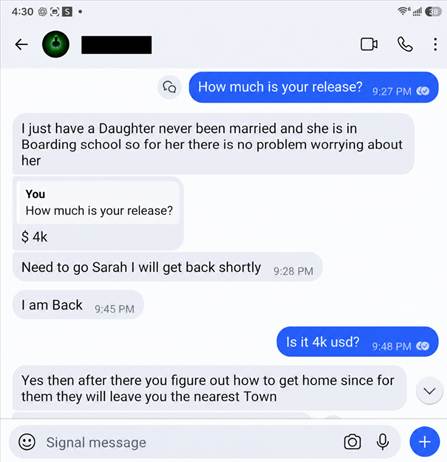
If someone says they are trapped, determine what trappedmeans. Are doors physically locked? Are armed guards present? Was the passport confiscated? Can they leave the building or compound? What happens if someone refuses to work? Have they been threatened or assaulted? Have they witnessed punishment? Are they told they owe a debt? Is payment demanded for release? Have workers tried to escape, and what happened to them?
Terrible working conditions, participation in criminal activity, and human trafficking are not interchangeable. Someone can hate working in a scam compound and still be there voluntarily. Conversely, someone may be able to visit a store or restaurant and still be unable to leave territory controlled by the group holding them.
You are trying to establish coercion, not simply unhappiness.
5 MINUTES
Establish Location - Without Increasing Risk
A trafficking victim may not know the compound’s name. They may have been transported at night, had their phone taken, crossed a border unknowingly, or know only an internal nickname.
Ask what they already know: the nearest city or town; visible signs, businesses, mountains, rivers, temples, churches, or landmarks; old photographs from arrival; drive time from a border crossing; or whether location services are already available.
Do not turn this into amateur intelligence collection at the victim’s expense. Never ask someone to sneak past guards, photograph a gate or armed personnel, climb onto a roof, or take any additional risk. No photograph is worth a beating - or worse.
LESS THAN 1 MINUTE
Know What Not to Do
- Do not make yourself the rescue operation.
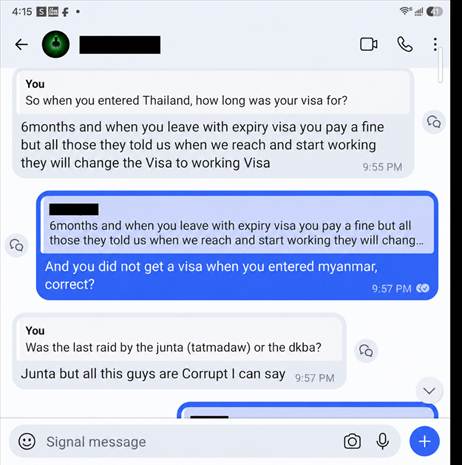
- Do not send ransom money because someone says it will secure a release. Some DKBA-controlled compounds reportedly accept ransoms up to $50,000 and still do not release the victim.
- Do not contact the compound or announce that you know whom it is holding.
- Do not publish the person’s identity or location while they remain inside.
- Do not instruct them to escape, photograph guards, or steal records.
- Do not promise that an embassy, NGO, law-enforcement agency, or Project Z Initiative will be able to get them out.
Your role is limited: establish enough information to determine whether the claim warrants escalation, preserve it safely, identify the appropriate pathway, and make a responsible referral. If an established government or NGO mechanism exists, use it. If no pathway exists, recognize that the case has become substantially more difficult - not that you should become more reckless.
15 MINUTES
Refer the Case
The safest starting point is generally the victim’s own government. Never contact the Myanmar military, the compound, an armed group, or an unknown intermediary advertising “rescues” online.
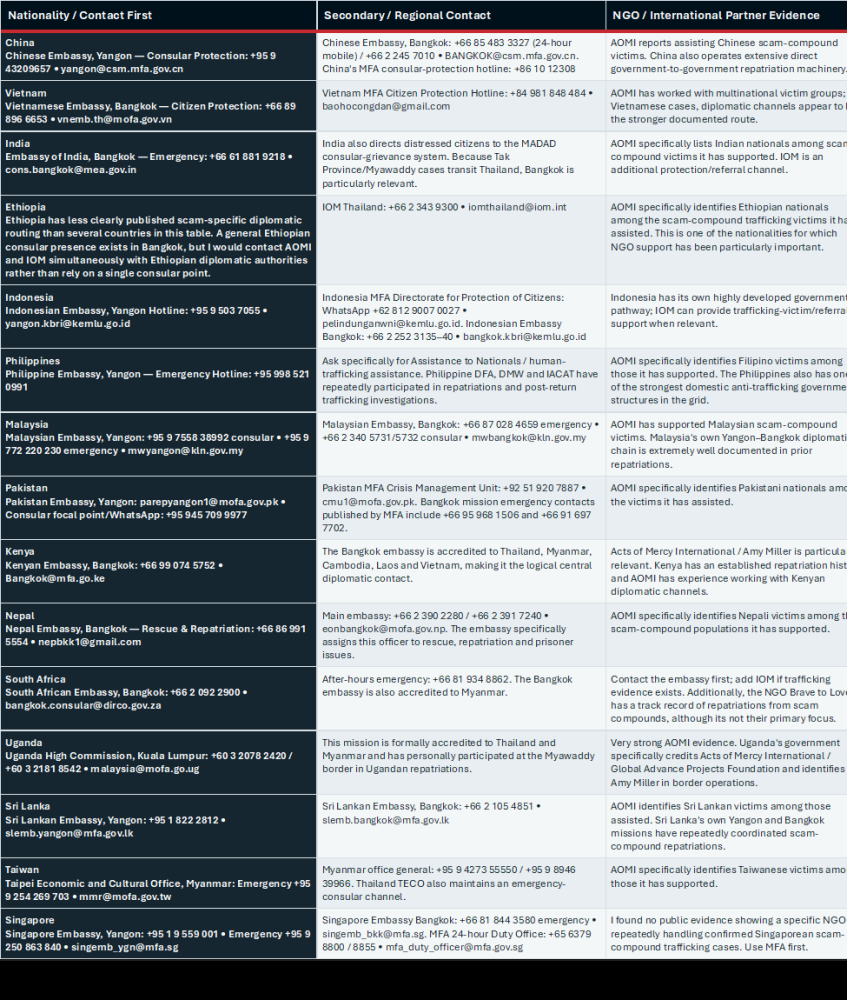
For people believed to be held around Myawaddy and the Thai-Myanmar border, contact both the country’s Myanmar-facing mission and its Thailand-facing mission where available. Many documented repatriations follow a Myanmar → Myawaddy → Mae Sot → Thailand pathway that requires both sides of the diplomatic network.
These contacts are reporting and consular-assistance channels, not rescue hotlines that dispatch people into compounds. Even the strongest governments generally must establish identity and nationality, determine location and circumstances, coordinate a lawful release or handover, and secure passage through Thailand.
If you are unsure where to start, email Sarah@ProjectZInitiative.org and we will help identify the right path and refer the case.
WHAT TO SEND IN THE FIRST REPORT
Full legal name • nationality • date of birth • passport or national-ID information, if available • current believed location • compound name, if known • nearest city • recruitment method • route into the country • whether they can leave • evidence of coercion or threats • whether documents were confiscated • release or ransom demand • safe means and times for contact • your own contact information.
“I am reporting a citizen of [COUNTRY] who says they are being held against their will and forced to conduct online scams in [LOCATION], Myanmar. I am requesting referral to the office handling trafficking victims, consular protection, and repatriation from Myanmar.”
Who Not to Contact Yourself
Do not independently contact compound management, guards, DKBA/BGF/KNA personnel, ransom brokers, Telegram “rescue agents,” or anyone claiming payment will guarantee release. Do not disclose publicly that a specific captive has contacted you. A government or experienced NGO may ultimately communicate with actors on the ground; that is very different from an unverified civilian doing it directly.
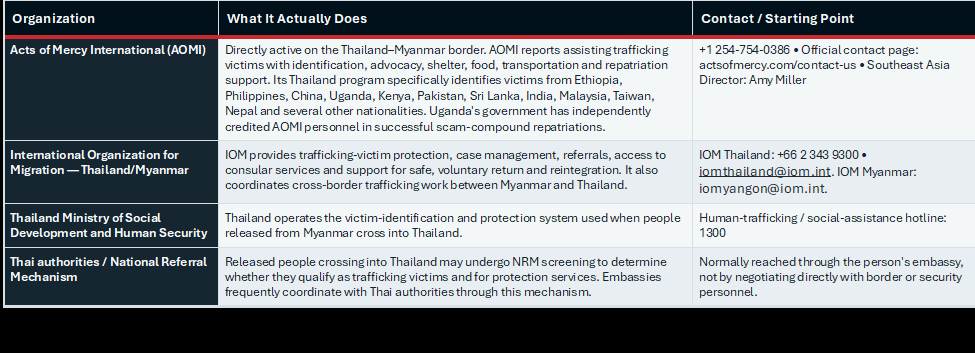
Regional Organizations With Documented Scam-Compound Work
Quick-reference starting points for trafficking-victim protection, consular coordination, and repatriation support.
Country-by-Country Starting Contacts
Use the victim’s nationality to identify the primary diplomatic channel; add a regional or NGO contact where appropriate.
When we first spoke, K told me why he had finally taken the risk of reaching out. His roommate, a Ugandan man, had become very ill. Guards said they would take him to a real doctor in Thailand. When they returned, they told K that the man had died. K asked where the body was and whether he could bury him. They said he had been cremated and the ashes were gone.
I do not know his roommate’s name. I do not know how he ended up there, how long he had been there, or whether anyone at home knew where he was. I do not know whether anyone ever asked him the question I asked K.
What I know is that K watched a man disappear from the world without even being given the dignity of burying him. That was what finally made him answer the stranger who had offered help.
Most of these messages are scams. The person sending them may be lying. They may be there willingly. Remain skeptical. But skepticism costs us nothing. Neither does one question.
The next time one appears, do not send money, click the link, or provide personal information. Do not believe a story simply because someone tells it to you.
Commit to potentially trading 38 minutes of your day for someone’s freedom.
Just ask.
Are you there willingly?